Master Meter vs Submeter vs Direct Meter: Key Differences
Last reviewed October 2026Reviewed by Grant Forehand, Compliance Officer, 20 years with NES
How a master meter, a submeter and a direct utility meter differ: who owns the meter, who bills residents, and which setup fits your property best.
What is the difference between a master meter, a submeter and a direct meter?
A master meter records utility use for an entire property on a single account, and the utility bills the property owner directly. Submetering leaves that master meter in place and adds private meters to individual units, so the owner bills each resident for actual use. With direct metering, the utility installs its own meter for every unit, bills each resident directly, and removes the owner from the process. Master metering hides individual use, while submetering and direct metering split costs based on what each resident consumes.
This guide is for owners, property managers, and board members managing communities with 80 or more units. You will learn how each utility setup works, what a retrofit involves, and how billing changes for your residents.
The three metering setups in plain terms
Each setup draws a different line between the city utility and the property owner. That line decides who owns the pipe, who reads the meter, and who collects the money.

Master meter
A master meter is one utility meter for the whole property or building. The utility reads this meter once a month and bills the owner for everything. You either absorb the water and power bills or build estimated costs into flat rent. When residents never see a bill for their own use, a running toilet in an empty bathroom can run for months unnoticed.
Submeter
A submeter sits on an individual unit, downstream of the master meter. The utility still bills the property owner, and private submeters track what each home consumes. Those submeter readings decide each resident's share of the master bill. The total billed to residents never exceeds the property's master-meter cost, while common areas like pools and laundry rooms stay with the owner. Our guide to what submetering is covers the basics.
Direct meter
Direct metering means the utility installs its own meter for each unit and bills the resident directly. Each resident opens an account with the city or electric company, and the owner is out of the billing entirely. The utility handles meter repairs, monthly statements, and delinquent accounts. Direct metering is common for electric service in newer buildings, but city water departments rarely offer it for older multifamily properties.
Comparing master meters, submeters, and direct meters
The choice between these setups determines who carries bad debt and who answers resident questions.
Who owns the meter
- Master meter
- Utility company
- Submeter
- Property owner
- Direct meter
- Utility company
Who the utility bills
- Master meter
- Property owner
- Submeter
- Property owner
- Direct meter
- Resident directly
Who bills the resident
- Master meter
- Nobody (or owner uses RUBS)
- Submeter
- Owner or submetering company
- Direct meter
- Utility company
What the resident pays
- Master meter
- Flat rent or allocated estimate
- Submeter
- Actual metered consumption
- Direct meter
- Actual metered consumption plus utility fees
Effect on conservation
- Master meter
- None; residents use utilities freely
- Submeter
- High; water use typically drops 15 to 30 percent
- Direct meter
- High; residents pay for their own consumption
Setup work
- Master meter
- None; standard base setup
- Submeter
- Install private meters behind master meter
- Direct meter
- Extensive utility engineering, permits, and meter banks
Owner's role
- Master meter
- Pays entire utility bill directly
- Submeter
- Pays master bill, recovers unit costs via billing
- Direct meter
- Completely uninvolved in tenant accounts
Converting a master-metered property: submetering vs direct metering
Owners often ask why the local water department cannot simply put a city meter on every apartment door. Converting a master-metered property to direct metering usually means meeting rigid utility rules, building new service lines or meter banks, and enduring major construction. Most city utilities will not take on hundreds of individual water accounts inside private buildings.
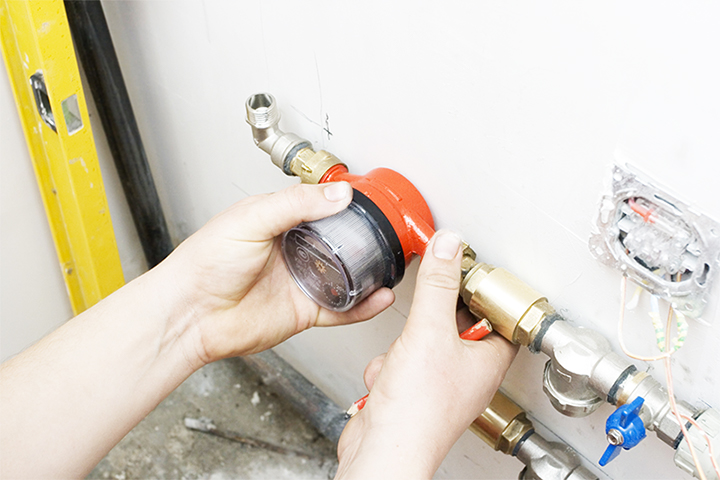
Submetering avoids that disruption by keeping the master meter and adding private meters behind it. You do not need to trench the parking lot or bring city mains to each apartment wall. Technicians install meters inside each unit, often in a utility closet or under a sink, tapping directly into the existing branch line. Our guide to water submetering covers how line access works.
Installation averages $150 to $300 per unit. Units where a water heater has to be moved to reach the line cost more, which is why one property can have a range of per-unit prices. Our guide to submetering cost walks through what moves the number.
When the line is easy to reach, a meter goes in in under 30 minutes, with the water off only briefly and notice given first. Nobody moves out. Most properties are billing within a few weeks to about 90 days and earn back the install in 12 to 18 months.
Water use typically drops 15 to 30 percent once residents pay for their own. At one 337-unit community, NES added meters as leases renewed, so for a while both setups ran side by side. The 168 submetered units averaged 3,868 gallons per unit per month, 34% less than the 5,846 gallons used by the 169 units not yet metered. Their average bill was $54.22 a month against $84.72, 36% lower, or about $30 per unit. Across all 337 units, that gap is worth roughly $123,000 a year.
When each utility setup fits best
Physical layout and budget dictate which strategy works:
- Master metering. Fits properties where plumbing lines cannot be isolated, local rules ban utility billing, or the owner plans to sell quickly without making plumbing upgrades.
- Direct metering. Fits new developments where the power company requires individual accounts, or single-family subdivisions with street access to every lot. Learn how developers plan these systems in our new construction submetering guide.
- Submetering. Fits existing communities of 80 or more units with centralized water or gas lines where the owner wants to stop absorbing utility bills without replumbing the whole building. Read about hardware options in our guide on types of submeters.
- Ratio utility billing (RUBS). Fits properties where split plumbing makes meter installation impractical. Ratio utility billing splits the master bill by a formula such as occupants or square footage. It needs no equipment, recovery starts with the first billing cycle, and it is not allowed everywhere. Read our comparison of submetering vs RUBS to see which method works for your building.
What changes for residents during a submetering conversion
Living under a master meter teaches residents that utility use is free. A running toilet or a leaking faucet does not change their monthly rent, so leaks go unreported for weeks.
Once submeters go in, each home receives a monthly bill based on actual consumption. Modern wireless submeters report several times a day. NES offers daily leak detection through its MyReads portal, which flags continuous flow (a running toilet, a leak) so it gets fixed before it adds up. Maintenance can knock on the door that afternoon instead of waiting for a swollen municipal bill a month later.
Residents will have questions about the first bill, so it helps if someone other than your leasing office answers them. NES reads the meters, sends the bills, handles collections and takes resident calls with its own bilingual team in English and Spanish. You can see how the program runs on our NES submetering services page.
Billing rules also change from state to state and sometimes city to city. Texas, for example, requires registration with the Public Utility Commission of Texas, and North Carolina requires a certificate from the North Carolina Utilities Commission before the first bill. Our compliance team checks the rules for your exact address before we quote. The meters we install are nonproprietary and yours to keep, with a warranty, so you are never locked in to NES.
Related questions
Get submetering and compliance updates
A short email when we publish new guides or a state changes its billing rules. No sales sequences, and you can unsubscribe any time.
We handle your email as described in our privacy policy.
Request a utility recovery estimate for your property
Send NES 12 months of master-meter bills and your total unit count, and a submetering specialist will reply within one business day with an assessment. Your complete utility recovery model follows within five business days at no cost and with no obligation. Call (800) 572-7060 to speak directly with an NES specialist about your property.